Most Tennessee homeowners assume their homes are properly insulated because they were built to code. But the reality is that Tennessee uses an amended 2018 IECC that uses 2009-era insulation tables requiring R-38 in attics (Climate Zone 4) and R-13 in wood-frame walls. These minimums represent the floor of acceptable performance, not the standard for comfort or efficiency. And even that insulation is undermined when air leaks go unaddressed.
However, ENERGY STAR recommends R-49 in attics for Climate Zone 4, which is nearly 30% more insulation than the TN code minimum. The U.S. Department of Energy notes that heating and cooling account for the largest share of a typical home’s energy costs, and under-insulated and unsealed homes waste significantly more.
In a state where summer temperatures regularly exceed 95°F and winters can dip below freezing, that gap matters. Combine that with unsealed air leaks, and many homes lose hundreds of dollars in energy every year while still feeling uncomfortable.
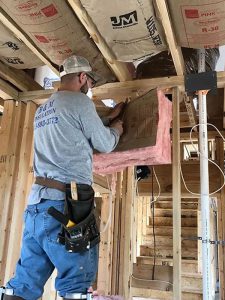
So what’s the fix? It’s not just adding insulation. It’s understanding how R-values in Tennessee insulation and air sealing for energy efficiency work together as a system.
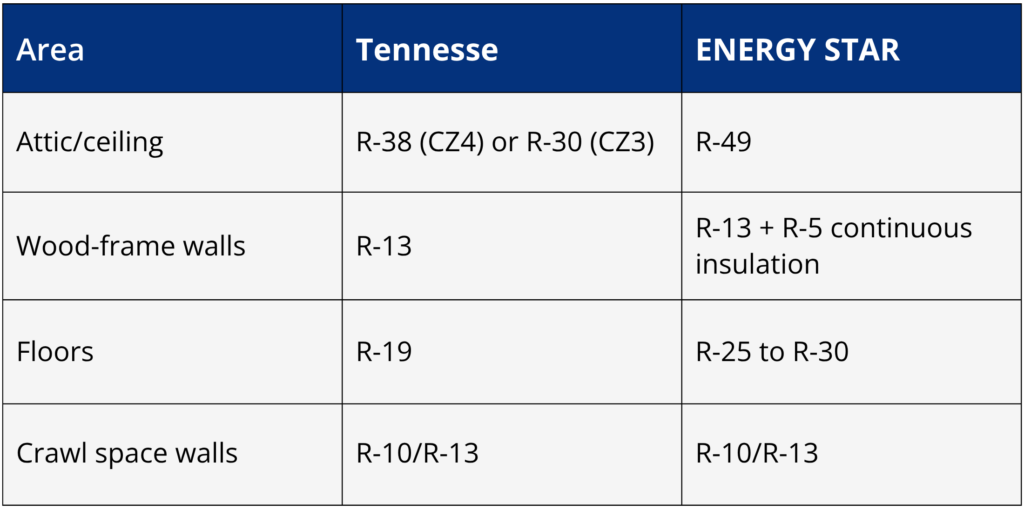
Tennessee’s amended 2018 IECC requires R-38 in attics (Climate Zone 4) or R-30 (Climate Zone 3), R-13 in wood-frame walls, and R-19 in floors. ENERGY STAR recommends R-49 in attics, R-13 plus R-5 continuous insulation in walls, and R-25 to R-30 in floors over unconditioned spaces. But insulation alone isn’t enough. Without proper air sealing, conditioned air escapes through gaps around pipes, light fixtures, and top plates, forcing your HVAC system to work harder. Combining insulation upgrades with air sealing can reduce heating and cooling costs by an average of 15%.
Not sure where your home stands? A professional evaluation can reveal exactly where your Tennessee home is losing energy.
What Tennessee’s Code Actually Requires
Code Minimum R-Values for Tennessee’s Climate Zones
Tennessee follows the 2018 IECC with state amendments that rely on older insulation tables from the 2009 IECC. That means requirements are lower than many homeowners expect.
For IECC climate zone 4 areas like Murfreesboro, Nashville, and Knoxville:
- Attic/Ceiling: R-38
- Wood-frame walls: R-13
- Floor: R-19
- Basement/Crawlspace walls: R-10 or R-13
For Climate Zone 3 areas like Memphis and western Tennessee:
- Attic/Ceiling: R-30
- Walls: R-13
- Floor: R-19
- Crawlspace walls: R-5 or R-13
These are the official Tennessee insulation requirements, but they only represent the minimum required by code. The DOE’s insulation guide confirms that R-value requirements vary by climate zone and building component, and that the installed R-value depends on material type and thickness.
What “Minimum” Really Means
Code minimums are the floor, not the goal. They represent the lowest-performing insulation a builder can install and still pass inspection. They’re designed to meet basic compliance, not maximize comfort or efficiency.
They also don’t account for real-world performance. A home can meet every requirement for attic insulation R-value Tennessee standards and still feel drafty, uneven, and expensive to heat and cool. That’s because they don’t account for Tennessee’s wide temperature swings – from summer highs above 95°F to winter lows well below freezing and because it doesn’t address air leakage.
Why Air Sealing Matters as Much as R-Value
Insulation slows heat flow, while air sealing stops air movement. A home needs both.
Even high R-value Tennessee insulation can’t perform properly if air is moving through it. Gaps around wiring, ductwork, top plates, and recessed lighting allow conditioned air to escape and outside air to enter.
That’s why the Department of Energy emphasizes combining insulation upgrades with air sealing. Without sealing, adding insulation is like wearing a sweater full of holes.
What ENERGY STAR and the DOE Actually Recommend
The R-Value Gap, Area by Area
When you compare code minimums to ENERGY STAR insulation recommendations, the difference is significant.
That means many Tennessee homes are under-insulated by 30% or more in key areas.
Why the Gap Matters in Tennessee
The DOE states that heating and cooling account for the largest share of a home’s energy use, and properly insulating reduces both energy costs and carbon footprint.
ENERGY STAR estimates homeowners can save about 15% on heating and cooling costs by improving insulation and air sealing. In Tennessee’s climate, where homes face both hot, humid summers and cold winters, those savings add up quickly. NREL’s ResStock analysis of Tennessee homes identifies upgrading attic insulation to R-49 as one of the top cost-effective energy efficiency improvements for the state.
For homeowners focused on home energy efficiency in Murfreesboro and across Middle Tennessee, closing this gap is one of the most effective upgrades available.
Which Upgrades Deliver the Best Return
Priority 1: Attic Insulation + Air Sealing
The attic is the highest-impact upgrade for Tennessee homes because heat rises and escapes through the ceiling in winter, and radiates down from superheated roof decks in summer.
Upgrading attic insulation R-value in Tennessee homes from R-38 to R-49 significantly improves energy performance. Pair that with air sealing around penetrations, ductwork, and top plates, and you dramatically reduce energy loss.
In addition, materials like the blown-in insulation Tennessee homeowners rely on, including cellulose insulation, is cost-effective and ideal for attic upgrades.
This combination consistently delivers the highest return on investment.
Priority 2: Crawl Space Sealing + Wall Insulation
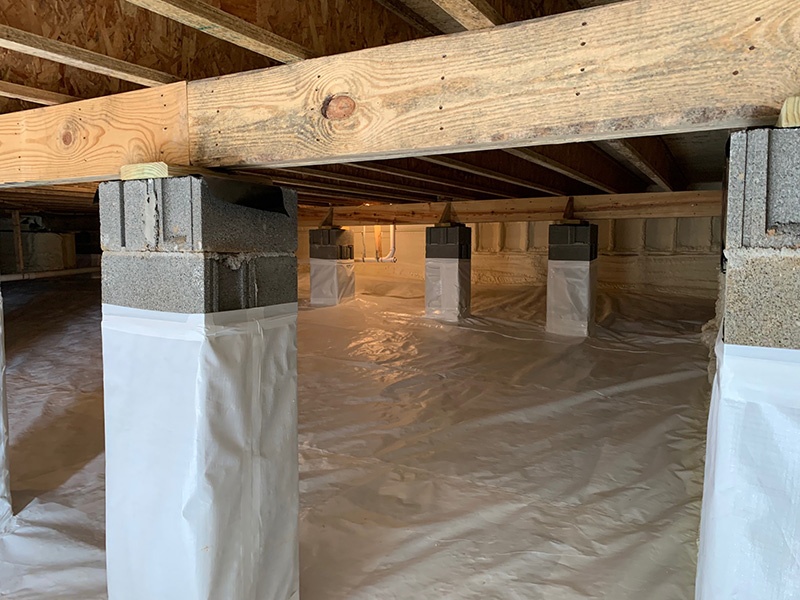
Moisture is a particular concern in Tennessee crawl spaces, but sealing air leaks and insulating crawl space walls can address both energy loss and moisture problems simultaneously.
Sealing air leaks and insulating improves both comfort and durability. For walls, adding R-5 continuous insulation to exterior walls when re-siding is an ideal opportunity for Tennessee homeowners planning renovations, as it can significantly boost performance beyond standard wall insulation R-13 levels.
In areas where air leakage is harder to control, spray foam insulation provides both insulation and air sealing in one step, making it a powerful solution.
Priority 3: Floors and Foundations
Floors over unconditioned spaces are often under-insulated.
While code requires R-19, ENERGY STAR recommends R-25 to R-30 for best crawl space insulation R-value performance. Upgrading these areas helps stabilize indoor temperatures and reduce drafts.
Slab-on-grade homes in Climate Zone 4 require slab edge insulation to R-10, but many older homes predate this requirement. For many homes, traditional materials like fiberglass insulation offer a cost-effective way to improve floor insulation performance.
Frequently Asked Questions
Tennessee’s amended 2018 IECC (using 2009 insulation tables) requires R-38 for ceilings/attics in Climate Zone 4 (Middle and East Tennessee) and R-30 in Climate Zone 3 (West Tennessee).
ENERGY STAR recommends R-49 for uninsulated attics and R-38 for attics that already have 3–4 inches of existing insulation in Climate Zone 4.
ENERGY STAR estimates homeowners can save an average of 15% on heating and cooling costs by air sealing their homes and upgrading insulation to recommended levels.
Blown-in cellulose and fiberglass are cost-effective for attic upgrades. Spray foam provides both insulation and air sealing in a single application, making it ideal for walls, crawl spaces, and hard-to-reach areas.
Insulation resists heat flow, but it cannot stop air movement. Air leaks around pipes, outlets, light fixtures, and top plates allow conditioned air to escape, forcing your HVAC system to work harder regardless of your insulation’s R-value.
TVA EnergyRight offers residential rebates for qualifying insulation, duct sealing, and air sealing upgrades. Tennessee is also preparing to launch IRA Home Energy Rebate Programs through TDEC’s Office of Energy Programs. Check our page for the most current rebate information.
Conclusion
Insulation and air sealing aren’t separate upgrades. They work as a system. Tennessee homeowners who address both enjoy lower energy bills, improved comfort year-round, and better long-term home value.
The biggest opportunity is in the attic: upgrading from R-38 to R-49 and sealing air leaks is the single most impactful improvement for most Tennessee homes. If your home was built to code, there’s a good chance it’s leaving efficiency on the table.
Contact B&M Insulation today for a free insulation evaluation. Our experienced team has been insulating and air sealing Middle Tennessee homes since 1976 – we install beyond code minimums so Tennessee homeowners get real comfort and real savings, not just a passing inspection. Call (615) 893-3772 or contact us now.
References:
ENERGY STAR. “Methodology for Estimated Energy Savings from Sealing and Insulating.” U.S. Environmental Protection Agency, www.energystar.gov/saveathome/seal_insulate/methodology.
ENERGY STAR. “Recommended Home Insulation R–Values.” U.S. Environmental Protection Agency, www.energystar.gov/saveathome/seal_insulate/identify-problems-you-want-fix/diy-checks-inspections/insulation-r-values.
ENERGY STAR. “Why Seal and Insulate?” U.S. Environmental Protection Agency, www.energystar.gov/saveathome/seal_insulate/why-seal-and-insulate.
National Renewable Energy Laboratory. “Tennessee Residential Energy Efficiency Potential.” ResStock, U.S. Department of Energy, resstock.nrel.gov/factsheets/TN.
Tennessee Department of Commerce and Insurance. “Energy Codes Courses.” Tennessee Fire Prevention, www.tn.gov/commerce/tfaca/codes-program/energy-codes-courses.html.
Tennessee Department of Environment and Conservation. “Home Energy Rebate Programs.” Office of Energy Programs, www.tn.gov/environment/program-areas/energy/state-energy-office–seo-/programs-projects/programs-and-projects/inflation-reduction-act/home-energy-rebate-programs.html.
U.S. Department of Energy. “Insulation.” Energy Saver, www.energy.gov/energysaver/insulation.